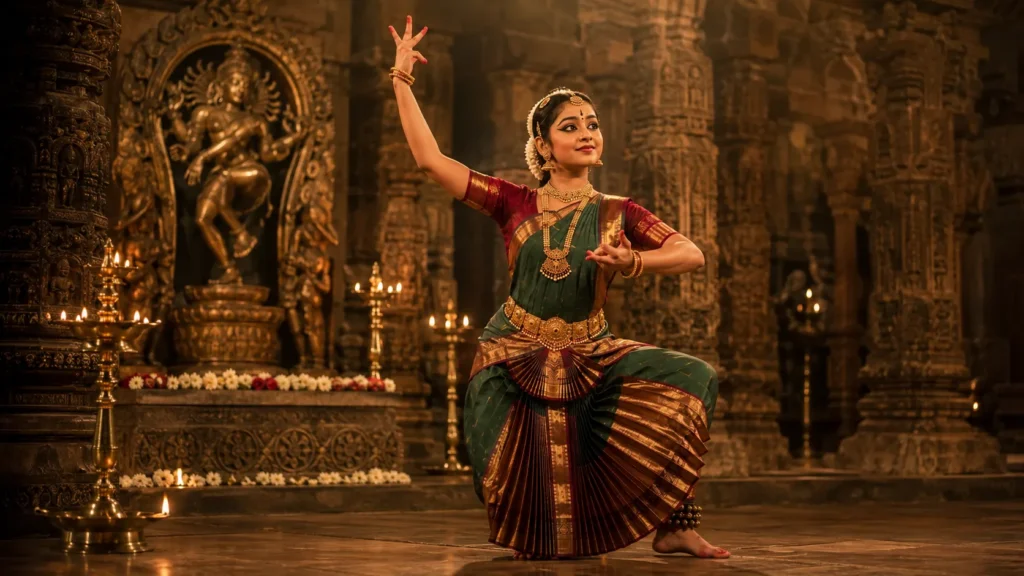
Bharatanatyam, one of India’s oldest classical dance traditions, has deep connections with Hindu religious traditions, mythology, temple culture, and devotional literature. While the form of Bharatanatyam as we know it today has evolved over centuries, its historical development is closely associated with the temples and cultural traditions of South India, particularly Tamil Nadu, where dance was performed as an offering and as a means of storytelling.
Here are some important connections between Bharatanatyam and Hindu scriptures and traditions:
Natya Shastra
Bharatanatyam draws upon principles described in the Natya Shastra, an ancient Sanskrit treatise attributed to Sage Bharata Muni. Widely regarded as one of the foundational texts of Indian performing arts, the Natya Shastra discusses various aspects of drama, music, and dance.
It provides detailed descriptions of mudras (hand gestures), angas (body movements), abhinaya (expressive acting), rasa (aesthetic emotion), and other elements of performance, many of which form an important theoretical foundation for Indian classical dance traditions, including Bharatanatyam.
Puranas
The Hindu Puranas, a vast collection of ancient sacred and mythological literature, contain numerous stories involving gods, goddesses, celestial beings, and divine dance.
One of the most significant examples is Lord Shiva as Nataraja, the cosmic dancer. His divine dance, particularly the Ananda Tandava, is associated with the cosmic processes of creation, preservation, and destruction. Bharatanatyam repertoire includes many compositions inspired by Lord Shiva and his various forms.
Hindu Epics
The two great Hindu epics, the Ramayana and the Mahabharata, contain numerous references to music, dance, performance, and celestial beings.
The Ramayana describes Apsaras, celestial dancers associated with the divine world, while the Mahabharata includes references to music and dance in royal courts, celebrations, and other social occasions.
These stories and characters have also become an important source of themes and narratives for Bharatanatyam compositions.
Devotional Literature
Bharatanatyam has a strong connection with bhakti, or devotional expression, particularly through the rich devotional traditions of South India.
Many compositions performed in Bharatanatyam, including keerthanams, padams, javalis, and other devotional pieces, express love, devotion, surrender, and longing towards Hindu deities such as Lord Krishna, Lord Shiva, Goddess Parvati, Lord Rama, and others.
Through abhinaya, dancers bring these stories and devotional emotions to life, allowing audiences to experience the spiritual and emotional depth of the compositions.
Temple Traditions & Inscriptions
Historical inscriptions found in temples across South India provide valuable evidence of dance, music, and performing arts being associated with temple traditions and religious ceremonies.
Some inscriptions record the presence of dancers, musicians, and other temple artists, as well as their roles and responsibilities. These historical records offer insight into the important place that dance and music held within the cultural and religious life of South Indian temples.
The Spiritual Connection
Bharatanatyam is much more than a sequence of movements. Its combination of nritta (pure dance), nritya (expressive dance), and natya (dramatic representation) allows dancers to communicate stories, emotions, philosophy, and devotion through movement.
Its connection with Hindu religious traditions, mythology, devotional literature, and temple culture reflects the profound spiritual and cultural heritage from which the dance tradition developed.
For generations, Bharatanatyam has served as a powerful medium of artistic expression, devotion, storytelling, and cultural preservation, creating a meaningful connection between the dancer, the audience, and India’s rich spiritual and mythological heritage.